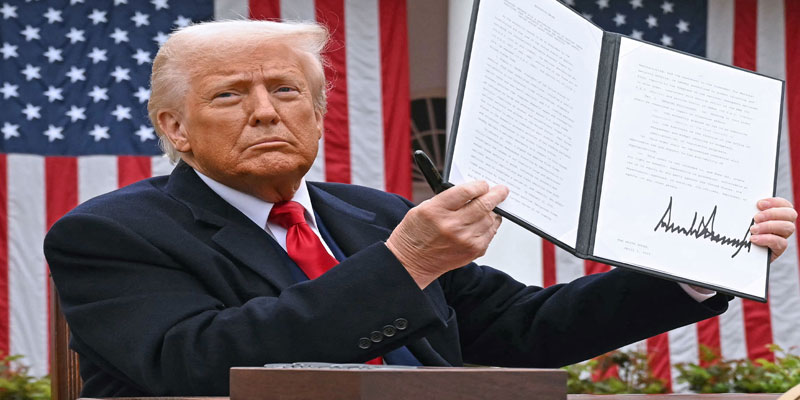
Court Ruling Raises New Questions Over Trump’s Global Trade Strategy
A major legal setback has hit Donald Trump’s aggressive trade agenda after a US trade court ruled that his proposed blanket 10% import tariffs were not legally justified under the law cited by the administration. In a closely watched 2–1 decision, the United States Court of International Trade held that the administration had exceeded the authority granted under Section 122 of the Trade Act of 1974.
The ruling means the tariffs will remain in force for all other importers while the Trump administration pursues an appeal. However, for the plaintiff companies and the state of Washington, the court ordered a halt to tariff collection and directed the government to refund duties already paid.
What the Court Actually Said
The central issue before the court was whether the administration could legally impose a flat 10% tariff on nearly all imports under Section 122, a rarely used provision intended for temporary action during balance-of-payments emergencies.
The majority opinion concluded that the administration failed to demonstrate the kind of economic crisis required under the statute. Judges also found that the tariffs were too broad and indefinite in nature to fit within the limited authority envisioned by Congress under the 1974 law.
While one judge dissented, arguing that the challenge may have been premature, the majority ruling significantly weakens the legal foundation of Trump’s across-the-board tariff push.
Importantly, the decision does not immediately eliminate the tariff nationwide. Instead, it offers relief only to the parties directly involved in the case unless future appeals or additional litigation expand the ruling’s impact.
Shift Toward Section 301 Tariffs
Despite the setback, trade analysts believe the ruling will not end Trump’s broader tariff ambitions. Instead, it is likely to accelerate the administration’s shift toward Section 301 of the Trade Act of 1974 — a more established and legally durable mechanism for imposing trade penalties.
Unlike Section 122, Section 301 allows the US government to impose tariffs against countries accused of unfair trade practices that burden American commerce. The Office of the United States Trade Representative has already launched investigations into several economies, including India, China, the European Union, Japan and Vietnam.
These investigations focus on issues such as industrial overcapacity, subsidies, supply-chain practices and alleged forced labour concerns. If unfair conduct is formally established, the administration could impose country-specific or sector-specific tariffs that are far more difficult to challenge legally.
Why the Ruling Matters Globally
The court’s decision reflects a broader tension in US trade policy: the clash between political demands for economic protectionism and constitutional limits on executive authority.
Trade experts, including former US diplomat Kurt Tong, argue that repeated legal defeats may force the White House to pursue more carefully documented and narrowly targeted trade measures rather than sweeping universal tariffs.
For countries like India, the ruling offers only partial reassurance. While courts may restrain the broadest tariff proposals, Washington’s pivot toward Section 301 means targeted trade actions could intensify in critical sectors such as steel, textiles, chemicals and electric vehicle components.
Trade Wars Enter a More Complex Phase
The latest court ruling does not dismantle Trump’s trade agenda, but it does compel a strategic recalibration. Blanket tariffs driven largely by political messaging now appear increasingly vulnerable to judicial scrutiny. In response, the administration seems poised to adopt more sophisticated, legally reinforced trade actions aimed at specific countries and industries.
That shift could make future trade conflicts more selective but also more persistent. As global supply chains continue to fragment amid geopolitical competition, businesses worldwide may face prolonged uncertainty, with tariffs becoming less dramatic in appearance but potentially more entrenched in practice.
(With agency inputs)